Fox ESS EQ Battery Series Review
We’ve been using it for decades; society is ruled by it and it’s our purest form of energy; electricity is the big topic of our time. When we talk about energy, we’re often just referring to electrons, and the world is replacing gas and oil with volts and watts on an accelerating basis. Our heating, cooking and driving are all being electrified, but with this singularity of energy forms, many have realised that they can store it to avoid the grid’s peak prices, either from generation themselves or through paying for cheap off-peak rates. Self-sufficiency and the opportunity to save money are very attractive. Crunching the numbers reveals a staggering reality: by properly leveraging home battery storage, your energy costs today could actually be lower than they were in the 1980s, in cash terms.
So, we decided to put the Fox ESS EQ Series to the test. In this review, we’re looking at what it actually takes to expand a modular home battery set-up, and whether this set-up has what it takes to power the all-electric future.
We need more batteries
Our solar and battery system went live earlier this year; we have 12× Aiko solar panels (detailed here from a previous project) that fed into an entirely Fox-based system; our inverter is the Fox H1 Hybrid Inverter Gen2 model, paired to a slave and master Fox ESS EQ4800 batteries, making a stack of two.
A few months into living with the system and monitoring our daily usage habits, it became clear that we were wasting energy by feeding excess solar generation back into the grid when export prices were low and also didn’t have enough battery capacity to shield us from the high peak electricity rates. We learnt this from a bout of misty days in June, where generation just couldn’t quite top up the batteries enough, and topping up with cheaper off-peak electricity to 100% battery charge would still leave it depleted during the day amongst the mist. So we figured, that when we creep into autumn and then into the bleakest of winter, we’ll be in trouble through being exposed to peak rate electricity prices, thus needing more storage to effectively offset this. Thankfully, as our system is the modular stackable Fox ESS EQ series home storage system, we are in a perfect position to demonstrate just how upgrading works and whether it makes sense. We've now lived with the system for over three months, allowing us time to build a proper review around it.
Fox ESS Product Lineup and Design
The core principle of the EQ systems is the same: expandable storage. But the variety of systems is broader, basically defined by their battery capacity, which is referred to in the product name of each, and once you have chosen a model, that is the one you have to stick with; you cannot mix battery sizes together in a stack. You can run two different model stacks concurrently with two Fox ESS inverters in most home set-ups, although there are single larger capacity inverters, typically aimed at businesses, that have multiple inputs for this purpose too. The EQ series includes the EQ2900, EQ4300, EQ4800 and EQ5000. We have the EQ4800 system, but everything we’re outlining in this review is applicable for the broader EQ lineup of battery systems and to the new Fox ESS CQ7 stackable system that can reach up to 98.28kWh of storage. How many batteries can be stacked varies on a per-model basis; with our set-up, the maximum number is one master and eight slaves for 41.94 kWh maximum capacity.
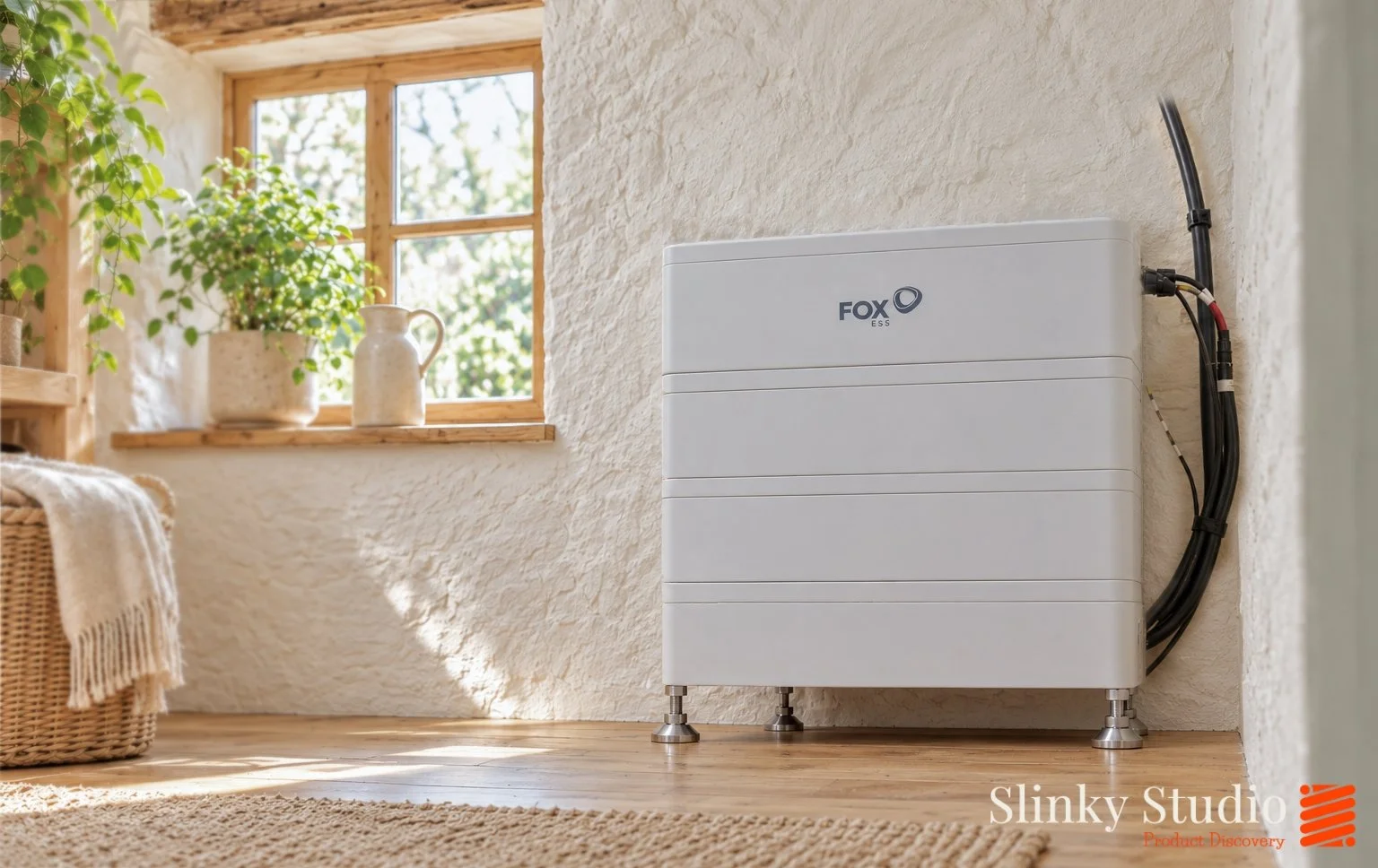
All the batteries basically look the same: white rectangular cubes. The clever interconnections that hold the stack together and do all the electricity pass-through and communications are hidden within the stack, so you’re left with what we think looks a relatively clean pile of white cubes, along with adjustable chrome feet on the bottom unit that keep the stack stable with air able to pass below. They’re surprisingly dimensionally compact, each of ours at 570mm x 380mm x 172mm, and have some LEDs that occasionally flash. They’re whisper quiet too, and are safe to be installed indoors or outdoors.
Expandable stackable storage, that’s as easy as Lego
Adding home batteries to an existing set-up sounds like something of huge complexity; in fact, that is actually the case with many systems. But that’s where stackable and, we’re pleased to say, easily expandable systems like the Fox ESS EQ range are an absolute revelation.
We weren’t quite ready for the hardest part of adding further batteries to our stack to be timing the upgrade, because the system has to be at 50% charge level at the time of upgrading. Once the magic number arrived, we put our system into backup mode, meaning our home was drawing from the grid and not the batteries. Then we proceeded with a full system power down, followed by lifting the first battery cube off, as this always remains at the top as it’s the master. Placing this to one side, each additional slave battery is added to the existing stack; a process that is as easy as pressing Lego bricks together. Albeit these are considerably heavier, at 39kg each, so it’s easier with two people, but the handles make the weight a manageable piece to manoeuvre. Then it’s just a case of replacing the master battery on top and turning the system back on.
Fundamentally, the system is now physically bigger, but this is where, even with the generation of inverter behind the one we have, the battery stack would not be seen as having additional capacity and would require programming. However, the Fox ESS H1 Generation 2 inverter that we have is completely automatic; it’s aware of the new batteries and joins the system together as one in a matter of minutes without any user programming or prompting needed. We could quickly see our additional capacity within the Fox ESS app, and the whole process took less than 10 minutes from beginning the install - we had now doubled our home battery storage capacity.
Extra Capacity In Action & Chemistry
In basic terms, we want to take cheap off-peak energy and apply it to our entire daily load, and that’s what the Fox EQ system makes possible. As we moved from the long days of summer into the shorter, mistier days of autumn, our energy dynamic shifted dramatically. Looking at our yearly data, July was a powerhouse month: solar generation peaked at nearly 1000kWh, easily covering our household load, charging the cars from surplus solar and still exporting to the grid.
By September and October, solar generation had dropped by 40-50% just as heating and daily usage began to climb. Without our recent expansion from two batteries to four, we would have been forced to rely heavily on expensive peak-rate grid imports. Instead, the expanded EQ4800 stack bridged the gap, and we haven’t run out of electricity before the off-peak period begins since adding the extra batteries. Ignoring EV charging, a typical day in September and October is 15-20kWh, and on some days half of that is heating.
Winter will push that up, likely to 30kWh a day based on previous years, with an even larger share going to heating. You might think that calls for more batteries, given our installed capacity of roughly 20kWh, but the off-peak window is six hours long and falls at night, often the coldest part of the day. Heating and the rest of the house is run on cheap electricity for that stretch, helped by load shifting things like the dishwasher. By our calculations we should get through winter with 10-15% of usable capacity left on the bleakest days, ignoring any solar. For now we often finish the day with 50% in the tank, although some days have less.
This heavy daily cycling is only possible because of the chemistry inside these units. We charge on cheap off-peak grid energy at night, then discharge deeply through the day as we work from home, and then on through the dark autumn evenings. Fox ESS uses Lithium Iron Phosphate (LiFePO4) cells, widely regarded as the gold standard for home storage. Unlike the batteries in older electronics, LiFePO4 is stable and safe, and it tolerates deep daily discharge without meaningful loss of lifespan. That’s what gives Fox ESS the confidence to offer a 10-to-12-year warranty, and it means we can push the system hard through the winter on off-peak charging rather than the sun.
How Fox ESS Batteries can generate income
When we first specced our system with just two batteries (including the solar), we calculated a payback period of 3 to 4 years based on our usage. However, a few things have happened since the installation that suggest our original projections were fairly conservative, namely, rising energy prices and more lucrative feed-in opportunities. While our original stack of two was an absolute no-brainer, adding another two modules requires a bit more evaluation. To figure out if it made sense, we had to take a close look at our yearly usage, weighing our peak unit rate of 34p against our 6.4p off-peak rate.
The numbers are compelling. During the six darkest months of the year, when our solar generation is at its lowest, we expect to use around 14 to 16 kWh of electricity per day from the batteries. By shifting this entirely to our off-peak rate rather than drawing from the grid during peak hours, we stand to save somewhere between £695 and £794 over that half-year period alone. If the peak unit rate does increase by 20% sometime next year, which is looking more likely, then the savings are that much better.
Exporting unused capacity on a variable tariff like Octopus Agile Outgoing makes things look even rosier, and Fox makes the arbitrage incredibly easy to do in their app. We charge overnight at 6.4p and can export when prices peak during the day (34.39p at the time of writing), which is a doddle and can prove very lucrative. In the six months when heating demand is lower, we often have over 10kWh of spare capacity that we could export each day. Giving this to AI, we’re told that trading would net over £500 across the period, entirely offsetting our winter costs. Systems exist that can automate this trading, but we’ve kept it manual so far. Combine these savings with our summer arbitrage and smart grid income, and the four-battery stack is on track to pay for itself in just under three years. The irony of the energy crisis is that the higher grid prices climb, the faster a system like this pays for itself, so it could even beat that.
That’s where automated platforms like Axle Energy come in, paying £1 per kWh on top of your standard export rate. Axle automatically discharges our Fox ESS EQ Series batteries to the grid during peak demand events. We’ve been using it for three months, mostly in summer, and it has already generated over £100. That puts us on track for £400 a year, and with winter demand events likely to be more frequent, we’re hoping to beat that. Add the savings from our winter shifting, and the financial case for expansion becomes hard to argue with.
The App Experience
There are a few things that really matter with a solar and home battery installation. The first is reliability, and the second is visibility and that is where the FoxCloud app comes in. When you are managing a system that can trade electricity, monitors solar generation, and balances your home's needs, the software is just as important as the hardware.
Of huge importance, this isn’t a smart-home app that is laggy or slow to engage with the product its supposed to represent. In three months of daily use, it has never failed to connect or execute a command; it’s simply very fluid and snappy. Even the user interface is straightforward in design, which provides a comprehensive, real-time visually illustrated overview of your energy flow. You can watch your solar generation, track your household consumption, and see exactly how much power is being drawn from or sent back to the grid. For those who want to dive deep, the data logging is superb, offering historical charts, with amazing in-depth analysis of supply and usage, that help you fine-tune your usage habits.
Where the app truly shines, however, is in its flexibility. Setting up 'electricity arbitrage’, charging the batteries at our 6.4p off-peak rate and discharging them during peak hours is incredibly straightforward via the mode selector. This allows you to easily programme different schedules to suit the seasons, ensuring you never draw from the grid when prices are high. Depending on your needs, you can switch between several core modes:
Self-Use Mode: Prioritises your solar generation for your home, storing the excess for the evening.
Feed-in Priority: Sends excess solar straight back to the grid and not into your battery.
Backup Mode: Keeps the batteries charged.
Peak Shaving: Allows you to set specific times to charge from the grid (like our off-peak window) and discharge when you need it most.
Verdict
After living with the Fox ESS EQ Series and expanding our system from two to four modules, one thing has become abundantly clear: while solar is fantastic, it is the batteries that do the heaviest financial lifting. By shifting our energy usage to off-peak hours, we are effectively paying 1980s prices for our electricity.
The transition to electric heating, cooking and in certain scenarios driving too, all demands a system that can grow with you, and that is where Fox ESS truly shines. Expanding our stack was as simple as clicking Lego bricks together, requiring zero complicated programming or professional rewiring. When you pair this physical flexibility with a rock-solid app and the ability to generate passive income through smart grid platforms like Axle Energy and Octopus Agile Outgoing, the EQ Series proves itself to be much more than just a storage unit.
There is a quiet revolution happening behind our walls. If you are looking to future-proof your home against rising energy costs, the Fox ESS EQ Series is a mature, reliable and highly scalable solution that we cannot recommend highly enough.